
FAIR Data Principles
Last updated on 2026-03-24 | Edit this page
Overview
Questions
- What does FAIR data mean?
- Is FAIR the same as open?
- How do I know if my data is FAIR?
Objectives
- Explain the four FAIR principles and what each means in practice
- Distinguish between FAIR data and open data
- Assess how FAIR a dataset is using a simple checklist
What Is FAIR?
FAIR is a set of guiding principles for research data, first published in Scientific Data in 2016. The acronym stands for:
- Findable
- Accessible
- Interoperable
- Reusable
These principles were developed to address a straightforward problem: a vast amount of research data exists but cannot easily be found, understood, or reused even by the researchers who generated it. FAIR is not a standard or a certification. It is a framework for thinking about what good data management looks like from the perspective of someone who wants to use your data in the future (including your future self).
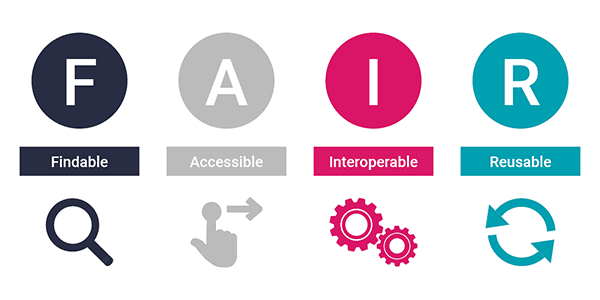
Wilkinson, M.D. et al. (2016) “The FAIR Guiding Principles for scientific data management and stewardship.” Scientific Data 3, 160018. doi:10.1038/sdata.2016.18
The Four Principles
Findable
Data should be easy to find, both for humans and machines. This means:
- Assigning a persistent identifier (such as a DOI) to your dataset so it can be reliably linked to and cited
- Describing the data with rich metadata: information about what the data contains, how it was generated, and how to access it
- Registering the data in a searchable resource such as a data repository
A dataset buried in a supplementary file attached to a journal article with no identifier and no metadata is not findable. A dataset deposited in a repository with a DOI, a descriptive title, and keywords is.
Accessible
Once someone has found your data, they should be able to retrieve it. This means:
- The data (or at minimum its metadata) can be accessed using a standard protocol such as HTTP or FTP, not a proprietary system requiring special software
- Authentication and authorisation may be applied where necessary (for example, restricted access to sensitive data), but the process for requesting access should be clear
- Metadata should remain accessible even if the data itself is no longer available so that others can at least discover what once existed
Interoperable
Data should be able to be combined with other data and used with different tools and workflows. This means:
- Using formal, widely used, and openly available formats (JCAMP-DX for spectra, CIF for crystal structures) rather than proprietary vendor formats
- Using shared vocabularies and ontologies, for example, identifying molecules using InChI or SMILES rather than informal names that may mean different things in different contexts
- Including references to other relevant datasets where appropriate
Interoperability is where chemistry has historically struggled most. Data from different instruments, groups, and fields often cannot be combined without significant manual effort, simply because no common formats or identifiers were used.
Reusable
Data should be sufficiently well described that it can be understood and reused by others (and by you, years later). This means:
- Providing rich provenance information: Where did the data come from, how was it processed, what instrument was used and under what conditions?
- Applying a clear licence so others know what they are permitted to do with the data (more on this in a later episode)
- Meeting community standards for the relevant domain. In chemistry, this might mean following IUPAC recommendations for spectral data or depositing crystal structures with the CSD
FAIR Is a Spectrum, Not a Switch
No dataset is perfectly FAIR, and improving FAIRness is an ongoing process rather than a one-time task. A dataset with a DOI and a clear licence is more FAIR than one without, even if it is not yet using a standard file format. The goal is to make incremental improvements, starting with the changes that have the biggest impact for the least effort.
The two highest-impact things most researchers can do immediately are: deposit data in a repository (gains F and A), and apply a licence (gains R).
Check Your Understanding: FAIR or Not FAIR?
For each scenario below, identify which FAIR principle(s) are being violated, and what could be done to fix it.
A. A researcher deposits their NMR spectra as proprietary Bruker
.fid files in Zenodo with a DOI, but includes no
information about the instrument, solvent, or compounds measured.
B. A paper includes the line: “Data are available from the corresponding author upon reasonable request.”
C. A dataset is deposited in a repository under a CC-BY licence with rich metadata and a DOI, but the files are in a format that requires a £500/year commercial software licence to open.
A violates Reusable (and arguably Interoperable). The dataset has a DOI (Findable) and can be downloaded (Accessible), but without metadata about the instrument, solvent, nucleus, or compounds, no one can interpret the spectra. The fix: add a README or metadata record describing the experimental conditions for each file.
B violates Findable and Accessible. There is no identifier, no repository, and no guarantee the author will respond or that the data will still exist in five years. Evidence suggests that “available on request” frequently means “not actually available”. The fix: deposit the data in a repository and replace the statement with a DOI.
C violates Interoperable (and arguably Accessible in practice). The legal access conditions are fine (open licence, accessible repository), but the data cannot actually be used without expensive proprietary software. The fix: export to an open format such as csv, json, mzML (for mass spec) etc., alongside the proprietary files.
FAIR Is Not the Same as Open
This is one of the most common misconceptions about FAIR. The two concepts are related but distinct:
- Open data means anyone can access and use it freely, with no restrictions.
- FAIR data means it is well described, findable, and usable – but it may still have access restrictions.
A dataset can be FAIR but not open: for example, sensitive patient data or commercially confidential compounds might be deposited in a repository with full metadata and a clear licence, but with access controlled so that only approved users can download the actual files. The metadata is still findable and the access process is clear. That is FAIR, even though the data is not open.
Conversely, data can be open but not FAIR: a file uploaded to a personal website with no metadata, no licence, and no persistent identifier is technically accessible to anyone, but it is not FAIR.
The principle to remember: metadata should always be as open as possible, even when the data itself cannot be.
Challenge: How FAIR Is Your Data?
Think of a dataset you have generated as part of a recent publication, even something simple like a set of analysis files from an experiment or a table of results. Or, if you can’t think of a specific dataset of your own, think of a dataset from a paper you have read recently.
Using the checklist below, score it against each FAIR principle. Be honest.
Findable
Accessible
Interoperable
Reusable
Discuss with your neighbour: which principle did you score lowest on? What is the single easiest thing you could do to improve your score?
For most researchers, the honest answer is that datasets can score very poorly or very well against FAIR principles. The point of the exercise is not to feel bad if your dataset scores low, but to identify the gaps.
The most common weak spots are:
- No persistent identifier – data is on a shared drive or a personal laptop, nowhere findable by anyone else
- No licence – data exists but legally cannot be reused
- Proprietary formats – spectra saved only as vendor files that require specific software
-
No metadata – files named
data_final.xlsxwith no accompanying documentation
The single highest-impact improvement for most people is to deposit data in a repository when publishing. This gains F, A, and often R in one step. We will cover how to do this well in Episode 5.
- FAIR stands for Findable, Accessible, Interoperable, and Reusable: It is a framework for making data useful beyond its original context.
- FAIR is not the same as open: data can be FAIR with access restrictions, and open without being FAIR.
- Metadata should always be as open as possible, even when the data itself cannot be shared freely.
- Most researchers’ current data scores poorly against FAIR principles – the goal is incremental improvement, not perfection.
- The highest-impact steps are depositing data in a repository and applying a licence.