
Why Does Research Data Management Matter?
Last updated on 2026-03-24 | Edit this page
Estimated time: 15 minutes
Overview
Questions
- What is research data and why should I care about managing it?
- What can go wrong if I don’t manage my data well?
- What is the reproducibility crisis and how does it relate to data management?
Objectives
- Define “research data” and “research data management”
- Explain why good data management matters for you, your research group, and the wider community
- Recognise the consequences of poor data management
Part 1: Research Data Management Principles
Episodes 1–5 cover the general principles of research data management that apply across all disciplines: what research data is, how to plan for it, how to make it FAIR, and how to store, share, and licence it. After the break, Part 2 applies these principles to the specific challenges of chemistry research.
What Is Research Data?
When you hear “research data”, you might think of a spreadsheet of results or a graph. In practice, research data includes everything generated or collected during a research project that is needed to validate your findings. In chemistry, this might include:
- Raw instrument output (NMR FIDs, mass spectra, IR interferograms, diffraction patterns)
- Processed spectra and images
- Lab notebook entries (paper or electronic)
- Synthesis protocols and reaction conditions
- Computational input and output files (DFT calculations, molecular dynamics trajectories)
- Code and scripts used for analysis
- Photographs, videos, and microscopy images
- Sample metadata (batch numbers, purities, supplier information)
- Calibration data and instrument logs
Research data is not just the final polished dataset attached to a publication, it is the full trail of evidence behind your conclusions.
What Is Research Data Management?
Research data management (RDM) is the organisation, storage, preservation, and sharing of data collected and used during a research project. It covers the entire research data lifecycle:
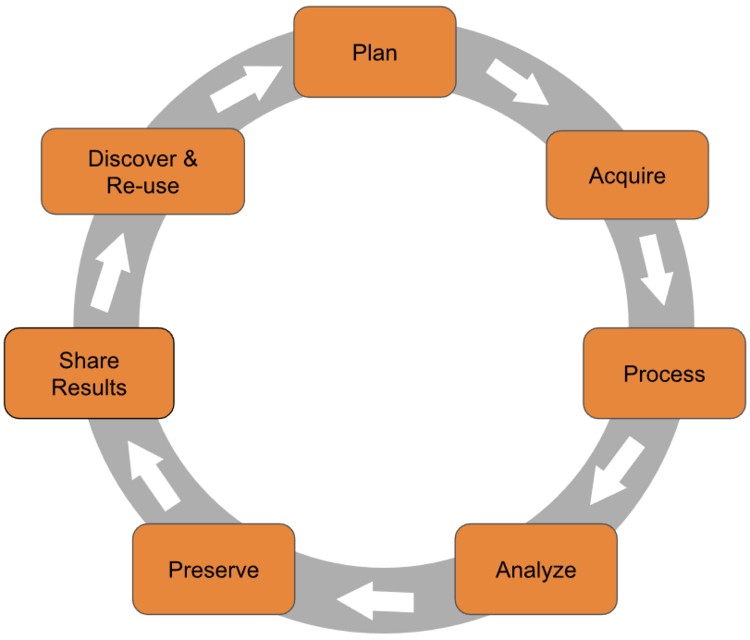
Good RDM means thinking about your data at every stage — not just when a journal asks you to upload a supporting dataset.
The Research Data Lifecycle
The research data lifecycle is a useful way to think about when and how data management decisions need to be made. Different models use slightly different labels, but the stages are broadly the same:
- Plan — Before you start: what data will you generate? How will you organise, store, and share it?
- Collect — Gather or generate data, recording metadata as you go.
- Process and analyse — Clean, transform, and analyse data, keeping records of every step.
- Store — Keep data safe, backed up, and well-organised during the active project.
- Share and preserve — Deposit data in a repository, apply a licence, and ensure long-term preservation.
- Reuse — Your data (and others’) can be found, accessed, and built upon by future researchers.
This workshop follows the lifecycle. Part 1 covers the general principles at each stage; Part 2 applies them to chemistry-specific scenarios.
Why Does It Matter?
Good data management is not just a bureaucratic requirement. It directly affects:
- Your future self. Will you be able to find, understand, and reuse your own data in six months? Three years?
- Your research group. Can a new PhD student pick up where a former group member left off?
- Reproducibility. Can other researchers verify and build on your work?
- Compliance. Most funders (including EPSRC and UKRI) now require data management plans and open data sharing.
- Efficiency. Time spent searching for files, re-running experiments, or reconstructing lost data is time not spent on research.
What Happens When It Goes Wrong
Data management failures are more common than you might think, and the consequences range from inconvenient to career-damaging.
The Unreadable Tapes
A major social science research group spent years and significant funding collecting a valuable dataset. The data was stored on magnetic tapes — the standard medium at the time. Years later, when researchers wanted to reuse the data, the institution no longer had hardware capable of reading those tapes. The dataset was effectively lost, along with the investment of time and money that went into collecting it.
Format Obsolescence
Proprietary instrument formats, old versions of software, and unsupported file types can all make data inaccessible over time. Saving your data in open, standard formats alongside vendor-specific formats is one of the simplest things you can do to protect against this.
The Retraction Cascade
A 2024 study in Royal Society Open Science analysed article retractions caused by data management errors. The researchers found that since 2000, data-related retractions have risen sharply — with data problems accounting for over 75% of retractions in 2023. The most common causes were incorrect data processing, data coding errors, and loss of documentation or materials.
Critically, retracted papers continue to be cited: the study found thousands of citations to retracted papers, many of which occurred after the retraction notice was published.
Williams et al. (2024) “Opening the black box of article retractions: exploring the causes and consequences of data management errors.” Royal Society Open Science. doi:10.1098/rsos.240844
The Overwritten Dataset
A PhD student generates raw mass spectrometry data for a key series of compounds. Under time pressure, they process the data and save the processed files over the originals — overwriting the raw data. Months later, they discover an error in their processing pipeline. Without the raw data, there is no way to recover. The experiments must be repeated from scratch, costing months of work.
This kind of scenario is avoidable with simple practices: keep raw data in a separate folder and set it to read-only, use consistent file naming, and make sure your data is backed up (more on this in a later episode).
The Reproducibility Crisis
In 2016, the journal Nature surveyed over 1,500 researchers about reproducibility. The findings were striking:
- Over 70% of researchers had tried and failed to reproduce another scientist’s experiments
- More than half had failed to reproduce their own experiments
- Chemists had the highest proportion of respondents who had been unable to reproduce someone else’s experiment
Despite this, most researchers still trusted published results and this confidence was most pronounced among chemists and physicists.
Baker, M. (2016) “1,500 scientists lift the lid on reproducibility.” Nature, 533, 452–454. doi:10.1038/533452a
The causes identified by respondents included pressure to publish, selective reporting, insufficient methods detail, and poor data management. Many of these are directly addressable through better RDM practices, which is exactly what this workshop is about.
Reproducibility in Chemistry
We will return to the reproducibility crisis in more detail in Part 2 of this workshop (Episode 6: The Reproducibility Crisis in Chemistry), where we look at chemistry-specific challenges and what the community is doing about them.
The Good News
Good data management is not difficult. It requires some upfront thought and a few consistent habits, but the payoff is enormous: less time wasted, fewer mistakes, better science, and compliance with funder and publisher requirements. The rest of this workshop will give you the practical tools to get there.
Challenge: Data Audit
Take 2 minutes to list all the different types of data you produce or use in your research. Think broadly:
- Raw data files from instruments
- Processed or analysed data
- Lab notebook entries
- Code and scripts
- Images and figures
- Metadata (sample details, instrument settings)
- Documentation (protocols, README files)
- Any other digital or physical records
Once you have your list, share it with your neighbour (or breakout room partner). Did they mention any types you missed?
There is no single right answer — the goal is to recognise how many different forms research data can take. Common items that people overlook include:
- Instrument calibration files and logs
- Email correspondence about experimental details
- Handwritten notes that never get digitised
- Negative or failed results that don’t make it into publications
- Software versions and environment configurations
- Sample provenance information (supplier, batch, purity)
If your list is short, that might indicate data types you are generating but not actively managing, and those are exactly the gaps that good RDM practices can fill.
- Research data includes everything needed to validate your findings — not just the final published dataset.
- Research data management covers the full lifecycle: planning, collecting, storing, sharing, and preserving data.
- Poor data management leads to data loss, retractions, wasted time, and irreproducible research.
- The reproducibility crisis is real and affects chemistry — but good RDM practices directly address its root causes.
- Good data management is not difficult; it requires some upfront planning and consistent habits.